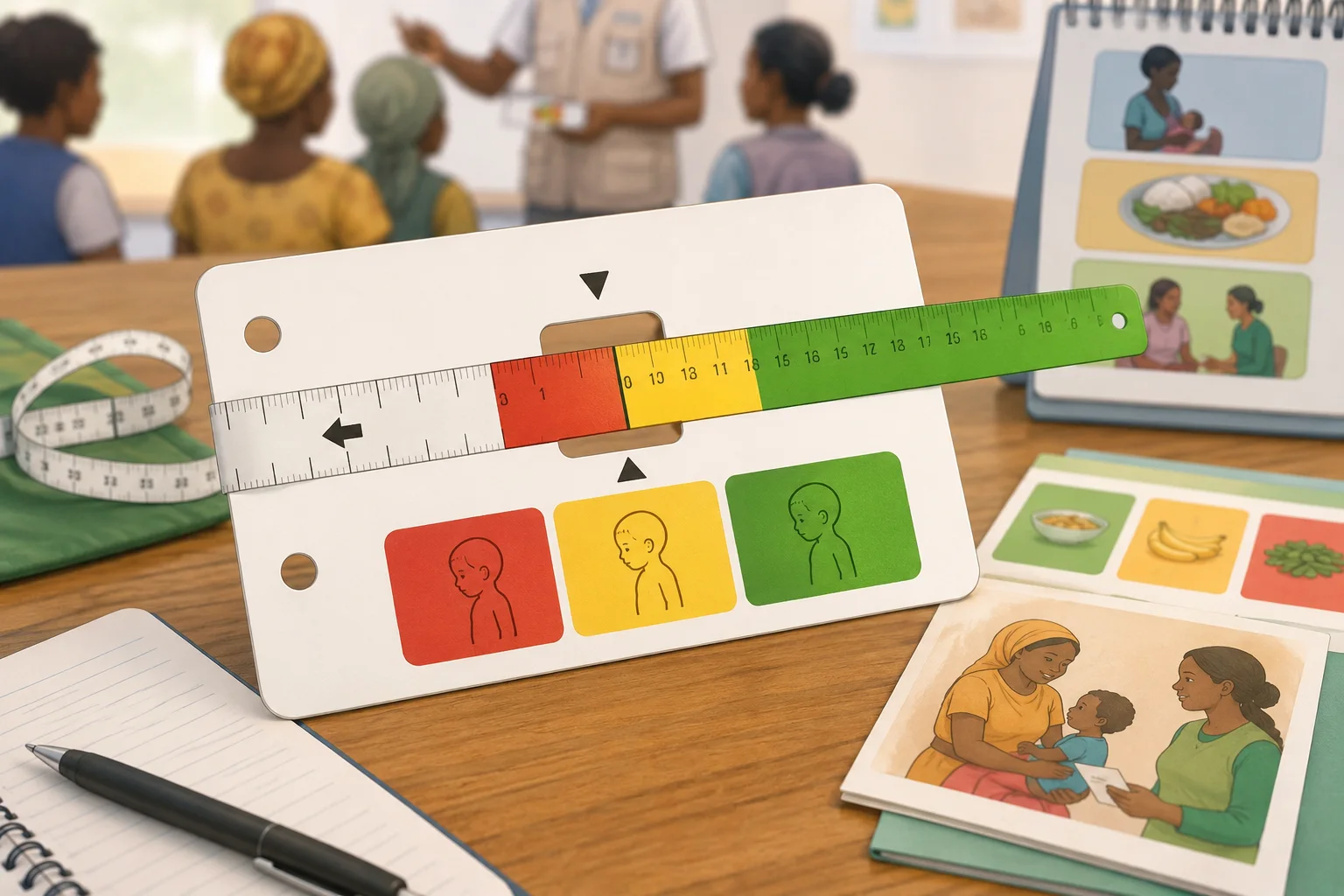
MUAC thresholds for children 6 to 59 months
MUAC is the mid-upper arm circumference. It is fast, low-cost and useful in community screening because it does not require a weighing scale or height board. For children 6 to 59 months, MUAC below 11.5 cm is commonly treated as a SAM screening signal, while 11.5 cm to below 12.5 cm suggests MAM risk.
The threshold is not the whole assessment. Bilateral pitting edema, illness, appetite, age, measurement technique and local protocol also matter. A low MUAC should be taken seriously because it can identify children who need urgent review.
- Below 11.5 cm: urgent SAM referral signal
- 11.5 cm to below 12.5 cm: MAM screening signal
- 12.5 cm and above: continue monitoring and routine care
- Any swelling, severe weakness or poor appetite needs professional review
How to measure MUAC correctly
Find the midpoint between the shoulder and elbow on the left upper arm, keep the arm relaxed and wrap the tape snugly without squeezing the skin. Read the value at eye level and repeat the measurement if the child moved or the tape slipped.
Common errors include measuring over thick clothing, pulling the tape too tight, using inches instead of centimeters and measuring a child outside the recommended age range. A printable MUAC card helps teams keep the threshold language consistent during training and outreach.
When SAM or MAM needs escalation
A SAM signal should not wait for repeated online checking. Re-measure once to rule out an obvious error, then follow the local referral pathway. MAM results also deserve action, especially when they appear with recent illness, poor appetite, repeated low weight or visible wasting.
This page is designed to support field education and caregiver awareness. It is not a treatment protocol. Always follow government, facility or program guidance where a child is being assessed directly.
SAM/MAM in the wider growth picture
SAM and MAM are acute malnutrition screening categories, so they are not the same as stunting or underweight. A child may have a low MUAC even when a caregiver does not notice height issues, and another child may be stunted without showing an acute MUAC signal. That is why this page links back to the full Poshan Calculator and the stunting, wasting and underweight explainer.
For search users, the distinction matters because many people type SAM MAM calculator online when they really need a quick threshold answer. This page gives that answer first, then explains that MUAC should be interpreted with the child's overall condition. That order helps both readers and search engines: the direct task is solved, and the supporting context is easy to follow.
Practical field workflow
A simple workflow is to confirm the child's age range, inspect for visible danger signs, measure MUAC carefully, re-measure if the tape slips and then decide whether the value is normal, MAM or SAM. If the child has swelling, poor appetite or severe weakness, do not rely on the number alone. Escalate according to local guidance.
When training volunteers or caregivers, use the printable MUAC card and explain the colors slowly. Red means urgent referral signal, yellow means moderate risk that still needs action and green means continue routine monitoring. Avoid saying a child is safe forever because of one green reading. Growth monitoring is a repeated process.
- Confirm age range before applying thresholds
- Place the tape at the upper-arm midpoint
- Do not squeeze the arm
- Repeat the reading if the child moved
- Escalate visible danger signs promptly
Why a printable MUAC card earns better links
The latest research showed that some competitors rely on low-quality forum and profile mentions. A safer authority strategy is to publish resources that a relevant website would genuinely cite. A MUAC card is one of those resources because it is easy to use in training, parenting content and NGO education pages.
The dedicated SAM/MAM MUAC Chart page gives outreach partners a clean landing page with the image, PDF, source notes and related pages. That keeps link equity on the site and helps readers continue to the calculator or the malnutrition term guide. The goal is not to get every possible backlink; it is to get relevant links that reinforce the child nutrition topic.
Language to use with caregivers
Use calm, practical wording. Instead of saying the child has a final diagnosis, say that the measurement is a screening signal and should be checked by a trained person. Explain what will happen next: re-measurement, review of appetite or illness, and referral if needed. Clear language reduces fear while still taking risk seriously.
Avoid blame. Low MUAC can be connected with illness, food access, feeding difficulty, repeated infections or many other factors. The purpose of screening is to find children who may need support, not to shame families. This wording also strengthens trust signals on the page because it matches public-health communication better than sensational claims.
Common questions during MUAC training
Training groups often ask whether MUAC should be measured on the right or left arm, whether clothing matters and whether a child can be measured while crying. The safest answer is to follow the local protocol and keep technique consistent. The arm should be relaxed, the tape should touch the skin or very light clothing according to protocol, and the reading should be repeated when movement makes the value uncertain.
A second common question is whether a normal MUAC means the child has no growth concern. It does not. MUAC is strong for acute malnutrition screening, but it does not replace age-based height and weight monitoring. That is why the calculator and chart pages remain linked from this SAM/MAM guide.