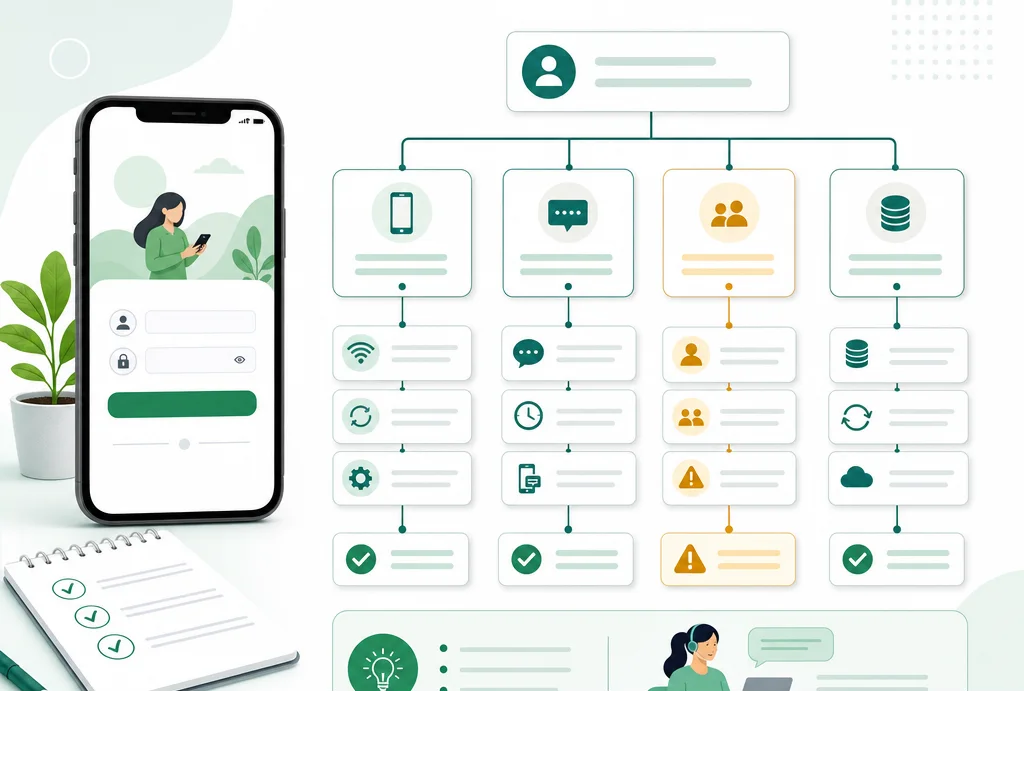
Error checklist before escalation
Check whether the app is current, the network is stable, the registered mobile number is correct and the account role still matches the worker assignment. If the problem started after an update, write down the app version and exact message before contacting a supervisor.
Avoid unofficial APK sites when trying to fix an error. They can expose credentials and may install outdated versions. Always return to official sources for app access.
Which error guide should you use?
Use the login page when credentials or portal access fails. Use the OTP guide when SMS delivery is the main issue. Use the no-data page when the user can enter the app but records, beneficiaries or dashboard data are missing.
This structure mirrors the problem-navigation pattern seen in the latest competitor research but keeps the advice safety-first and source-backed.
Record the issue clearly
For repeated problems, note the time, district or project context if relevant, app version, device model, network type and exact error message. Clear notes reduce repeated troubleshooting and help supervisors identify whether the issue is local, account-based or platform-wide.
Login failure vs app error vs data error
A login failure happens before the user reaches the account. The cause may be OTP, password, number, role or server response. An app error happens when the app crashes, freezes, fails to update or blocks a screen. A data error happens after login when expected beneficiaries, center records or dashboard values do not appear.
Separating the error type matters because each one has a different next step. Login issues go to the login and OTP pages. App update or install issues go to the app download guide. Missing records go to the no-data page. A single mixed page would be harder to rank and less useful for the user.
What not to do when an error appears
Do not install random APK files, do not share OTPs in comments, do not post screenshots with personal details and do not create duplicate beneficiary entries before checking sync or assignment. These shortcuts can make the problem worse and may expose sensitive information.
Do not assume every error is caused by the user. A wider service issue, configuration change or role update can create the same message across many devices. Collecting clean evidence is more useful than repeatedly reinstalling the app without a plan.
A practical error report template
Use a simple template: what screen failed, exact message, app version, device model, network type, time of issue, whether other users are affected and what was already tried. This makes escalation clearer and keeps support conversations focused on facts.
For training teams, the login error decision-tree PDF can be printed and shared. It gives a quick path for common questions while linking back to the full online guide for updated details and official source links.
Why this troubleshooting cluster helps rankings
The latest research showed that a calculator plus login, errors and download structure can earn real search traffic in this niche. The improvement here is to keep the cluster safer and more useful than low-quality competitors: no fake APK recommendations, no credential collection and no unrelated content.
Each error page links to the others in a controlled way, so users can move from a broad error query to a specific fix. That internal linking also helps search engines understand that these pages belong to the same Poshan Tracker support topic.
Priority order for common errors
Start with safety, then access, then data. Safety means confirming the user is on official channels and not a fake APK. Access means login, OTP and role. Data means beneficiary visibility, sync and filters after successful login. This order prevents users from trying advanced fixes before basic checks.
If the issue is urgent for field work, record the facts before trying more changes. A clear note can be escalated; a long series of undocumented reinstall attempts is harder for anyone to diagnose.
How field teams can reuse this guide
Training teams can treat this page as the troubleshooting index. The decision-tree PDF can be used offline, while the page itself stays updated with links to specific OTP, login, no-data and app pages. This creates a cleaner resource than forwarding many scattered screenshots.
For external links, the best citation is usually common Poshan Tracker errors guide or Poshan Tracker troubleshooting resource. These anchors are descriptive without over-optimizing exact-match keywords.
Signals that need official escalation
Escalate through official channels when the same error affects many workers, when the role or assignment is wrong, when the registered number has changed, when records are missing after sync checks or when the app shows a message that users cannot resolve locally.
Do not send passwords, OTPs or child details to unofficial support accounts. A good troubleshooting guide should reduce unsafe behavior, not create a new place where users share sensitive information.
Error categories for internal linking
The site treats errors as a cluster with four routes. Login errors go to the login help page. OTP delivery goes to the OTP page. Missing records go to the no-data page. Install or update uncertainty goes to the app download page. This structure keeps the current page useful as a hub while giving specific queries their own focused answers.
This is also a deliberate SEO choice. The competitor research showed that problem-navigation pages can bring traffic in this niche. The improvement here is to build that navigation cleanly, with official-source cautions and without copying low-quality backlink or keyword-stuffing patterns.
Using this page as an outreach asset
The error hub is a good outreach target for Anganwadi, ASHA, training and local health education pages because it solves a recurring operational problem. Suggested natural anchors include common Poshan Tracker errors, Poshan Tracker troubleshooting guide or app error checklist.
The goal is to earn relevant citations where the page genuinely helps readers. Avoid paying for unrelated links, APK directories or forum profile placements. A smaller number of topical links will support authority better than a larger number of irrelevant mentions.