Start with the official portal
Use the official Poshan Tracker portal or the official app listing from Google Play. Avoid entering credentials into third-party pages, copied login forms, APK download sites or pages that claim to be official without matching government sources.
If a page asks for your password, OTP or worker credentials and is not the official portal or official app, leave the page. This website provides guidance only and does not collect login details.
Common login checks
Before escalation, confirm the mobile number, OTP delivery, app version, network quality and whether the account is active at the correct worker or supervisor level. Many login problems are caused by stale OTP attempts, old app versions or role changes that need supervisor confirmation.
- Update the app
- Check SMS permission and signal
- Restart login after clearing stale OTP attempts
- Ask the supervisor if the user role changed
- Use the decision-tree PDF for training or repeated field questions
When to escalate
Escalate when the same account fails on a stable network after app update, when the registered mobile number is wrong, when the role appears changed or when the dashboard does not match the worker's assignment. Do not keep requesting OTPs repeatedly if delivery is failing.
A safe login troubleshooting order
Follow a fixed order so the same issue is not checked again and again. First confirm that the user is on the official app or portal. Second, verify the app version and network. Third, check the registered mobile number and OTP flow. Fourth, confirm role or center assignment. Fifth, collect the exact error message for escalation.
This order turns a vague search query into a useful action path. It also matches the problem-navigation pattern found in the latest SERP research, where users move from login help to OTP, app download, common errors and no-data pages. Keeping each issue on a separate page gives Google a clearer page-to-query match.
Credential safety reminders
Login help pages can attract people who are frustrated and willing to try unsafe fixes. That makes safety language part of the SEO product, not just a legal note. Never share OTPs, passwords, worker IDs or screenshots that reveal personal data in public comments, social messages or third-party support forms.
If someone claims they can unlock an account through a private APK or copied login page, treat it as unsafe. The only safe path is the official app, official portal or department-approved support channel. PoshanTracker.org does not provide login, password reset or account access.
What to write before contacting support
Good notes shorten troubleshooting. Record the device model, app version, time of the attempt, network type, registered mobile number status, role or assignment if known and the exact words on the error screen. Do not include passwords or OTPs.
If multiple workers have the same issue at the same time, note that pattern. It may indicate a wider service or configuration issue rather than one person's device. If only one account is affected, the issue is more likely tied to number, role, assignment or device state.
Why this page links to the calculator
A login problem is different from child growth calculation, but the audiences overlap. A worker who fixes access may still need a printable chart or calculator explanation during field work. A caregiver who lands here by mistake can move to the public calculator without entering credentials anywhere.
This internal path is deliberate. It builds topical authority around Poshan search intent while keeping official account work separate from public awareness tools. That separation is safer for users and cleaner for SEO.
Mistakes that waste time
The most common time-waster is reinstalling the app before checking the basic cause. If the number is wrong, reinstalling will not fix OTP. If the role is inactive, clearing cache will not restore access. If many users have the same issue, the problem may not be one device.
Another mistake is searching for a shortcut and landing on unofficial APK or copied login pages. Those pages can look helpful because they promise a fast solution, but they create credential risk. The safer route is slower for a few minutes but better for the account and the user.
How to use the decision-tree PDF
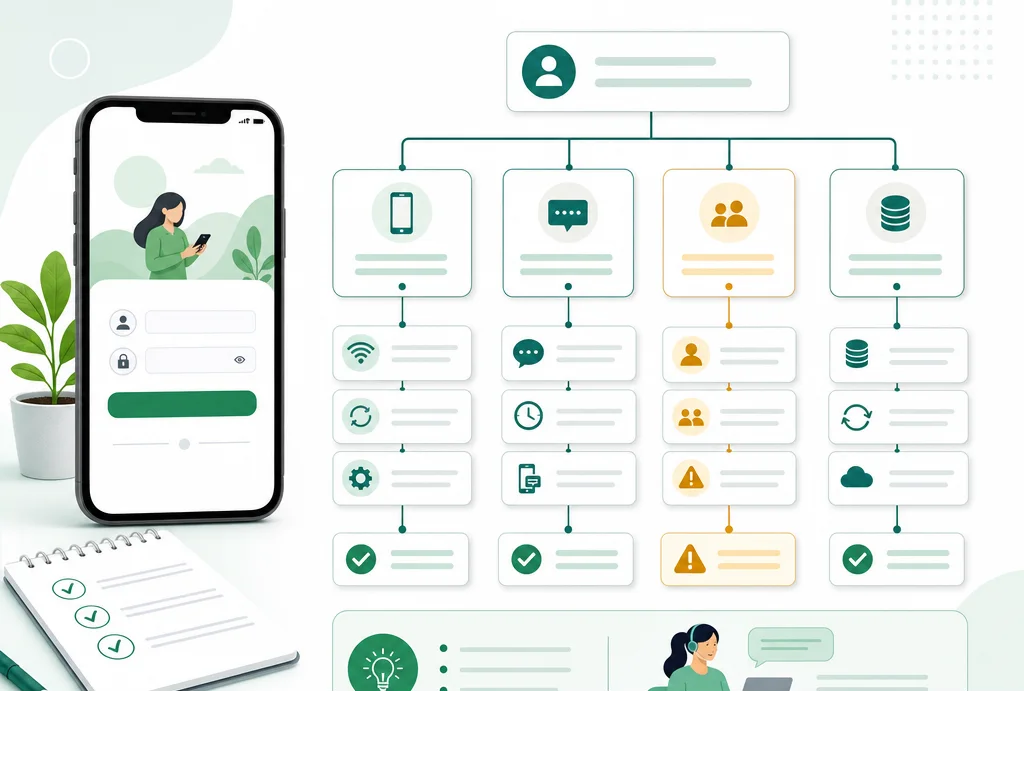
The login decision-tree PDF is meant for repeated field questions. Print it, share it in training or use it as a checklist before escalation. It starts with official access, then separates app, OTP, role and no-data issues so the next step is easier to choose.
When another site or training document links to the PDF, it should link to this page or the PDF resource hub rather than only the file. That keeps source notes, disclaimers and updated guidance attached to the resource.
Privacy checklist for screenshots
Screenshots are useful, but they should be cleaned before sharing. Cover phone numbers, names, IDs, OTPs, passwords and beneficiary details. Share only what is needed: the error text, screen name, app version and time.
This privacy wording is not optional decoration. It is part of making a trustworthy health-adjacent support page and helps distinguish the site from low-quality troubleshooting content.
How this page should be linked from other sites
If a training page, parenting article or local resource list mentions Poshan Tracker login issues, the safest link target is this guide rather than a copied login form or unofficial APK page. Good anchor text includes Poshan Tracker login help, safe Poshan Tracker troubleshooting or official access guidance.
The page is designed for editorial links because it gives a complete answer, warns against credential risks and routes users to specific follow-up pages. That kind of link is more useful for authority than profile links or unrelated comment mentions.
Checklist for supervisors and trainers
For repeated questions, trainers can use this sequence: confirm official app or portal, check app version, check registered number, check OTP behavior, check role or assignment, then collect the exact error. The downloadable decision tree mirrors this order so it can be used offline.
This checklist is intentionally simple. It reduces unsafe improvisation and helps teams avoid telling users to install random files or share credentials. A good troubleshooting page should make the safer action the easiest action.