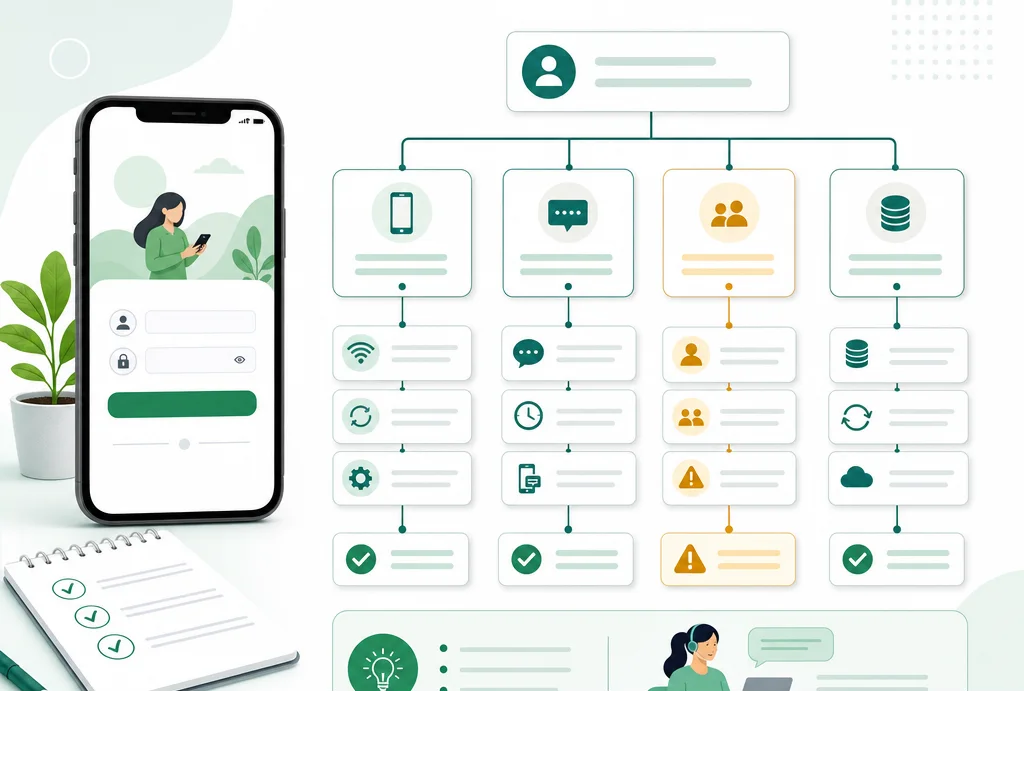
Why data may be missing
The app may show no data when the account role has changed, the user is assigned to a different area, beneficiary records have not synced or filters are hiding expected records. A stable login does not always mean the account has the right data visibility.
Avoid recreating records until the assignment and sync status are checked through official guidance. Duplicate or incorrect entries can create more work later.
Safe checks
Confirm the worker role, project or center assignment, app version, network status and any date or category filters inside the official app. If a supervisor can see the data but the worker cannot, the issue is likely account or role based.
What to report
Report the exact screen, the expected record type, whether other users can see the data and when the issue started. Do not share passwords or OTPs in screenshots.
Role and assignment mismatch
A no-data message often appears after login, so users assume the app is broken. Sometimes the account is active but assigned to the wrong role, project, center or geography. If the worker sees a dashboard but not the expected records, role and assignment should be checked before device reinstall attempts.
A supervisor or authorized channel may be able to confirm whether the expected beneficiaries are linked to the account. This website cannot check assignments. It can only help users collect the right details before escalation.
Sync and filter issues
Data may also be hidden by filters, date ranges, categories or incomplete sync. Check whether the app is showing a default filter, whether internet connection is stable and whether the same record appears on another authorized device. Do not create duplicate records just because one view appears empty.
If the record appears after changing filters or reconnecting, write down the cause so the same problem is easier to solve next time. If the record never appears but should be visible, the issue should be reported with exact details.
Safe screenshot practice
Screenshots can help explain no-data issues, but they can also expose personal information. Before sharing a screenshot, remove or cover names, phone numbers, IDs, addresses and any OTP or password fields. Use official support channels rather than public social comments.
This privacy guidance is part of E-E-A-T for the page. It shows that the content is designed for real users, not just for ranking.
Why this page is separate from login help
Login help solves access. No data found solves visibility after access. Combining them into one page would make the advice less precise and create a weaker keyword match. A separate page gives Google and users a clearer answer.
The page links back to the common errors hub because some users will not know which category they are in. That hub then routes them to OTP, login, app download or no-data content.
Questions to ask before changing records
Can another authorized user see the record? Did the account role change recently? Are filters active? Is the device online? Did the issue start after an update? Is the expected beneficiary linked to the current assignment? These questions should be answered before any record is recreated.
Changing or duplicating records before understanding the cause can create cleanup work and confusion. A no-data message should be treated as a visibility issue first, not proof that the original record does not exist.
Local vs account-level issue
If the same account shows data on another device, the issue may be local device state, network or app cache. If the same account shows no data everywhere, the issue is more likely assignment, role, sync or record linkage. If many accounts are affected, the issue may be broader.
This distinction helps users give useful information to supervisors. It also makes the page more than a keyword landing page; it becomes a practical diagnostic guide.
How to document safely
Write the expected record type, the screen where data is missing, whether filters were checked, whether another authorized user can see the record and the time the issue was noticed. Do not include personal beneficiary details in public channels.
If a screenshot is necessary, crop or cover private information. Treat child data and worker credentials as sensitive even when the problem feels routine.